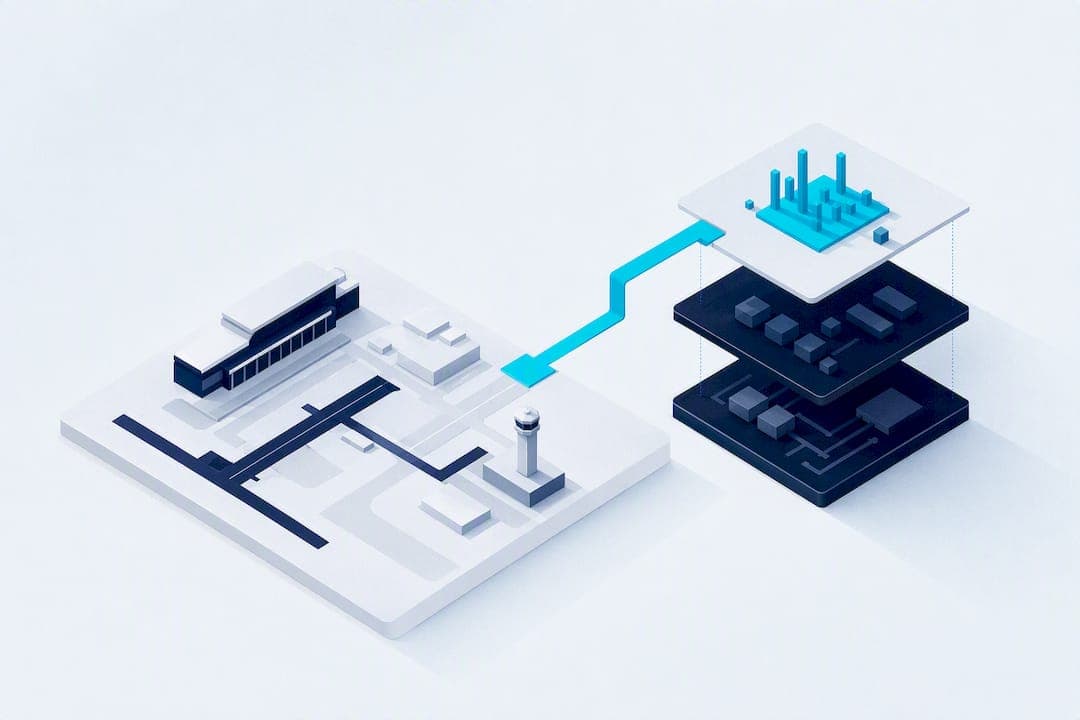
An airport digital twin is a live 2D or 3D model that mirrors terminal, airside, and landside operations in real time, fusing IoT sensors, flight data, and camera feeds with a spatial model of the facility. The payoff is concrete: faster decisions during disruptions, fewer bottlenecks at security and gates, and better use of staff and equipment. Airports that deploy one well don't start with the technology. They start with a single operational problem worth fixing, then scale from there.
TL;DR:
- Focusing on a specific operational problem like passenger flow or baggage handling ensures quicker, measurable results within months.
- Use open standards such as NGSI-LD and FIWARE for data integration to avoid vendor lock-in and streamline deployment.
- Successful pilots often leverage existing sensor coverage to deliver results faster and more reliably than those relying on new hardware.
- A no-code platform can drastically reduce setup time by enabling teams to build and test a digital twin without custom coding or extensive integration.
- Documented deployments have reported capacity gains of up to 28 percent and delay reductions of around 18 percent in real airport environments.
Table of Contents
- What Is an Airport Digital Twin, and How Is It Different From a 3D Map?
- Where Should Operations Teams Target a Pilot First?
- What Data and Architecture Does an Airport Digital Twin Need?
- How Do You Roll Out an Airport Digital Twin Without Overbuilding It?
- What Governance Mistakes Quietly Kill Twin Projects?
- What Do Real Airport Digital Twin Deployments Actually Show?
- When Does an Airport Digital Twin Actually Make Sense?
- Build Your First Airport Digital Twin Pilot Without the Integration Headache
- Sources
- FAQ
What Is an Airport Digital Twin, and How Is It Different From a 3D Map?
A 3D rendering of a terminal is a picture. An airport digital twin is a working model, and the difference comes down to what feeds it and what it lets you do with that data.
Every twin rests on a static base: BIM or CAD files from construction, 3D laser scans, and GIS layers that define where everything physically sits, from jet bridges to baggage carousels. That base is inert on its own. It becomes a digital twin once real-time data starts flowing into it, things like IoT sensors on HVAC units, flight and ADS-B feeds, baggage scanner logs, and camera-based crowd analytics.
On top of that live layer sits analytics and simulation. This is where a twin earns its name. Instead of just showing you what's happening at Gate 14 right now, a good simulation layer can run a what-if scenario: what happens to queue times if you add two more staff at security lane 3 during a peak arrival bank?
The functional split looks like this:
- Static base model: BIM/CAD drawings, 3D scans, GIS geometry — the unchanging shell.
- Real-time feeds: sensors, cameras, scanners, flight data — the pulse.
- Simulation and prediction: scenario testing, capacity forecasting, anomaly detection — the brain.
- Two-way control: some twins let operators push changes back into physical systems, not just watch them.
That last point separates a genuine operational twin from a passive dashboard. A visualization tells you something is wrong. A twin with two-way capability lets you test a fix before you commit staff or equipment to it.
Where Should Operations Teams Target a Pilot First?
Not every use case deserves equal attention out of the gate. Some deliver measurable returns within months; others take years of data maturity to pay off. Ranked by realistic near-term impact:
- Passenger flow and queue optimization. Camera-based crowd analytics feeding a twin can flag congestion at security or immigration before it becomes a visible line, giving supervisors time to redeploy staff instead of reacting to complaints.
- Baggage handling visibility. A twin that overlays scanner and conveyor data on the physical layout turns "the belt jammed again" into root-cause analysis: which sorter, which shift, which recurring mechanical fault.
- Turnaround and gate utilization. Simulating aircraft turnaround sequences against gate assignments helps planners shave minutes off dwell time, which compounds across a full day of departures.
- Predictive maintenance. Feeding sensor data from elevators, baggage sorters, and HVAC units into a twin's analytics layer catches degrading equipment before it fails during peak operations, as explained in detail in AI w utrzymaniu ruchu: ile realnie zyskujesz na przestojach.
- Landside and sustainability dashboards. Curb management and emissions tracking round out the picture, useful for regulatory reporting even if they rarely deliver day-one operational drama.
Pro Tip: Pick the use case with the most existing sensor coverage, not the one with the biggest theoretical payoff. A twin that starts with data you already have will show results in weeks instead of waiting on a hardware rollout.
What Data and Architecture Does an Airport Digital Twin Need?
The architecture question trips up more projects than the visualization itself. You need four layers working together, and each one has real technical decisions attached.
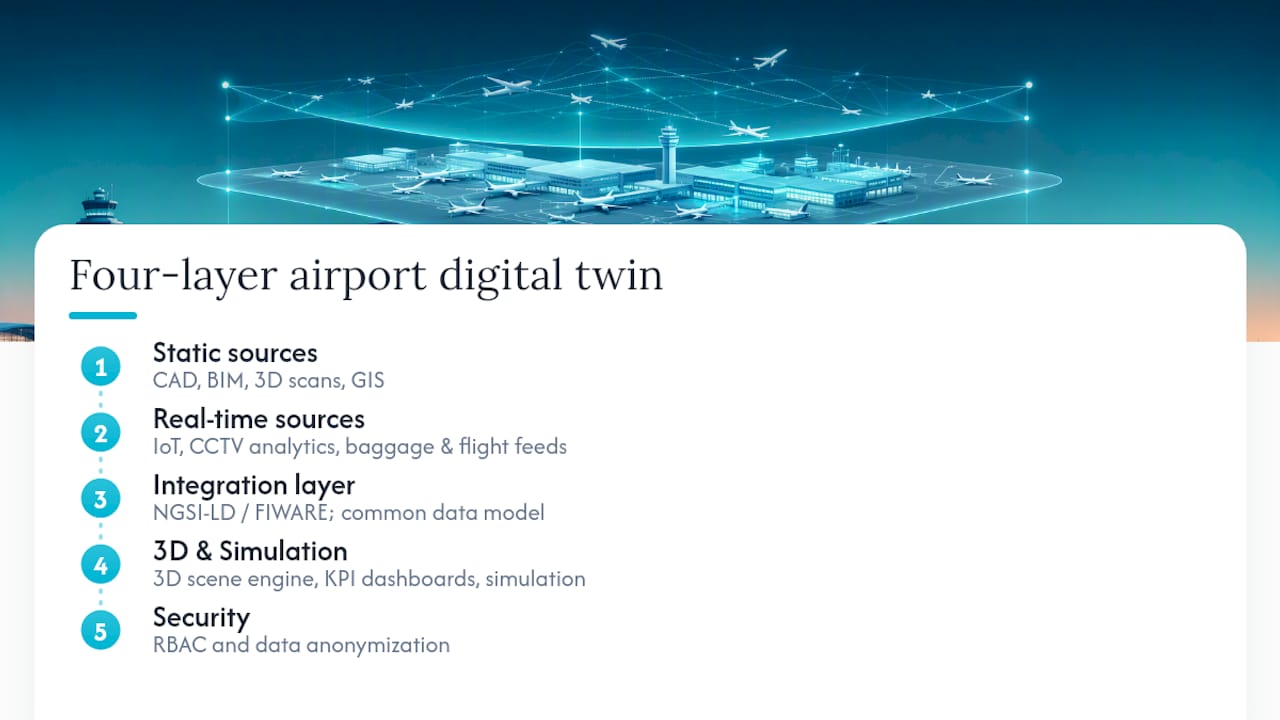
Static sources come first: CAD and BIM files from facility construction, 3D scans for spaces that predate digital records, and GIS base layers for site-wide geometry. If your terminal was built before 2010, expect gaps here that need physical re-scanning.
Real-time sources are the harder problem. IoT sensors, CCTV analytics, baggage scanner logs, and flight or ADS-B feeds all arrive in different formats, at different frequencies, from different vendors. This is the part that eats budget.
Integration is where most projects live or die. A context broker built on NGSI-LD and FIWARE standards normalizes disparate feeds into a common data model, which matters enormously once you're pulling from five or six source systems instead of one. AWS's own guidance for airport digital twin architecture recommends ingesting both historical and streaming operational data, then using purpose-built IoT and scene-composition services rather than custom-building every integration point from scratch.
On top of that sits the visualization and simulation stack: a 3D scene engine for the spatial model, dashboards for KPI tracking, and a simulation engine for scenario testing.
Security can't be an afterthought. Passenger-facing data needs role-based access and anonymization before it ever reaches a dashboard that contractors or third-party vendors can view.
How Do You Roll Out an Airport Digital Twin Without Overbuilding It?
Airports that get real value from a twin follow roughly the same sequence, and the airports that stall almost always skipped step one.
- Define the business outcome first. Not "we want a digital twin," but "we want to cut average gate turnaround by 8 minutes" or "we want to reduce security queue complaints by half." Pick the technology after you know the target.
- Choose a narrow pilot. Baggage handling, one terminal's gate turnaround, or passenger flow in a single security zone. Resist the urge to model the entire airport on day one.
- Assemble a cross-functional governance team. Operations, IT, airline partners, and security all touch the data a twin needs; leaving any of them out creates gaps later.
- Execute the pilot. Map the data sources, build a lightweight model, run simulations against real historical scenarios, and validate the output against what actually happened.
- Measure, iterate, then scale. Only after the pilot proves a measurable outcome should you connect it to broader systems like an Airport Operations Center or an integrated AIOC.
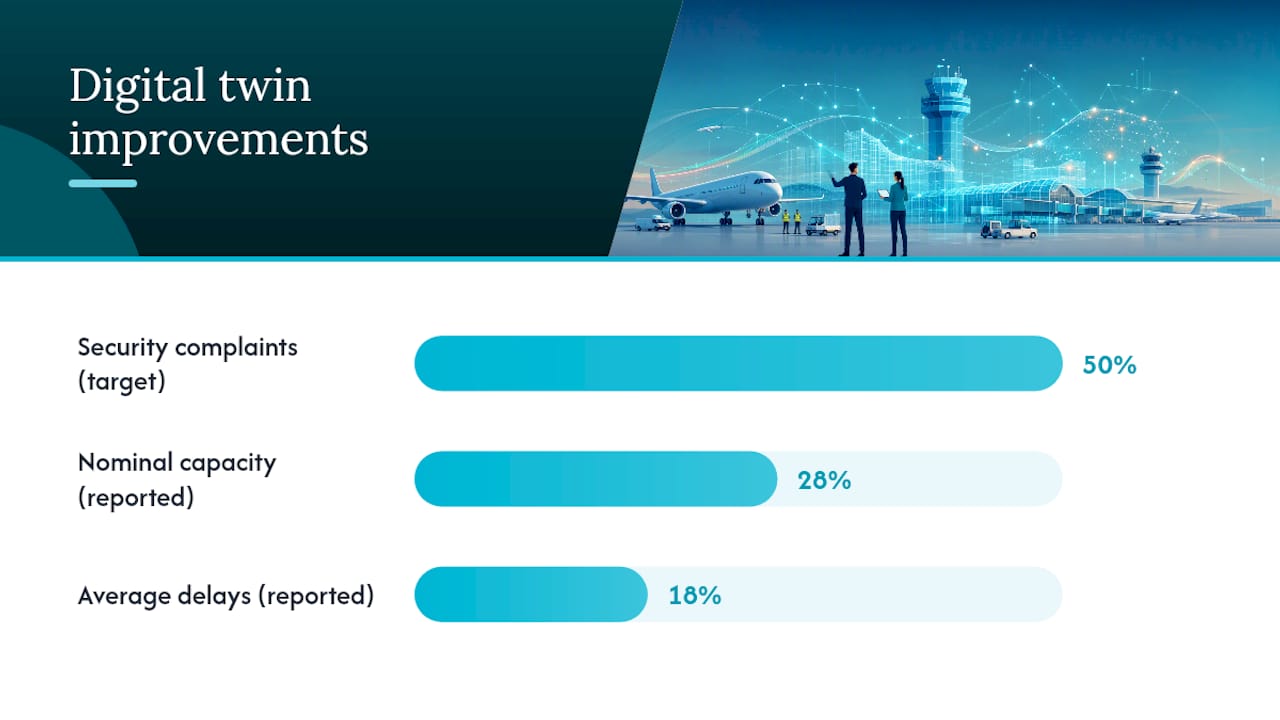
A simulation-based digital twin implementation reported up to a 28% improvement in nominal capacity and roughly an 18% reduction in average delays in a real airport case. Simulation-based capacity modeling also tends to give more realistic estimates than rough analytical methods, which matters when you're deciding how much runway capacity to actually sell to airline partners.
Budget and timeline expectations should stay conservative. Data mapping alone, getting CAD models, live feeds, and legacy systems talking the same language, typically consumes more project time than the visualization work that follows it.
What Governance Mistakes Quietly Kill Twin Projects?
The technology rarely fails outright. What fails is the process around it, usually in ways that don't show up until six months in.
- No clear data owner. Someone has to be responsible for refreshing the model after every physical change, or the twin drifts from reality and staff stop trusting it.
- Proprietary lock-in. Favoring open standards like NGSI-LD and FIWARE over a closed vendor stack keeps you from being trapped when you want to add a new data source later.
- Underfunded maintenance. Ongoing data hygiene, checking sensor calibration, updating base models after construction, needs dedicated staff time, not a one-time integration budget.
- Weak access controls. Passenger movement and biometric-adjacent data need anonymization and restricted views, the same way any operational security system does.
- Over-scoping the pilot. Trying to model the whole airport before proving value on one process is the single most common reason projects stall before they ship anything usable.
Pro Tip: Treat model drift the same way you'd treat a stale map app. If nobody owns the update process, the twin becomes a liability the first time an operator makes a decision based on outdated geometry.
What Do Real Airport Digital Twin Deployments Actually Show?
The evidence isn't theoretical anymore. Several major airports have run twins long enough to report real operational data.
- Vancouver International Airport (YVR) has run its digital twin continuously since 2022, with more than 1,100 employees using it to coordinate passenger flow, resource allocation, and baggage handling. YVR describes the system as a single source of truth that breaks down the silos between departments that used to operate on separate spreadsheets and radio calls.
- San Francisco International Airport (SFO) built its twin's static base model across 18 million square feet of interior space, integrating more than 600,000 infrastructure features into a system tied to its Airport Operations Center.
- Rajiv Gandhi International Airport in Hyderabad launched an AI-powered digital twin built around crowd management, queue analytics, and passenger experience monitoring, paired with virtual simulations for planning.
- Simulation-based approaches at other airports have shown up to a 28% capacity gain and an 18% delay reduction in documented trial deployments. These are the same figures cited in the implementation roadmap above.
- The Digital Twin Consortium's airport operations guidance points to generative AI layered on top of twins as the next practical step for automated operational insight.
When Does an Airport Digital Twin Actually Make Sense?
Not every operational problem needs a twin. If your bottleneck is a broken handoff process between two departments, fix the process. A twin won't repair bad communication, it will just visualize it more expensively.
The right test is whether your problem is fundamentally spatial and data-rich: something where seeing multiple live feeds overlaid on the physical layout would change what a supervisor does in the next ten minutes. Baggage jams, gate congestion, and queue buildup pass that test. A staffing policy dispute doesn't.
Vet vendor claims by asking three questions: what's the actual data source behind their demo, how long did their reference deployment take before showing results, and can you pilot on one terminal zone before signing anything enterprise-wide. Tools like Kingfisher's no-code 3D SCADA platform matter here mainly because they lower the cost of that first honest test, letting a team build a working pilot scene without a six-month integration contract standing between the idea and the evidence.
— Jeffrey Anastacia
Build Your First Airport Digital Twin Pilot Without the Integration Headache
Every deployment described above, YVR, SFO, Hyderabad, took real engineering time to stand up. That's the trade-off with a fully custom-built twin: powerful once it's running, slow to get there. Kingfisher's no-code 3D SCADA platform closes that gap by letting operations teams drag and drop a working scene together in a browser, with real-time data binding and no scripting required.
The platform's AI-powered scene generation can turn existing schematics or facility photos into a working 3D layout, and the built-in marketplace of ready-made components means a baggage handling or turnaround pilot doesn't start from a blank canvas. Kingfisher has already supported a digital twin management build for an airport client, proof that the no-code approach scales past a proof-of-concept demo. Browse the airport-relevant solutions Kingfisher supports, or check the case studies page to see how the platform handled that airport deployment, then reach out to scope your own narrow pilot before committing to a full enterprise rollout.
Sources
- YVR Digital Twin | YVR
- Airside Optimization Framework Covering Multiple Operations in Civil Airport Systems with a Variety of Aircraft: A Simulation-Based Digital Twin
- Guidance for Building a Digital Twin for Airport & Airline Operations on AWS
- India's first AI-powered airport digital twin launched at Hyderabad airport
FAQ
What Is an Airport Digital Twin?
It's a live 2D or 3D model of an airport that integrates real-time data, IoT sensors, flight feeds, cameras, and baggage systems, with analytics and simulation to support operational decisions.
How Long Does It Take to Deploy One?
A narrow pilot covering one process, like gate turnaround or baggage handling, can show measurable results within months, though data mapping between legacy systems and the model typically takes longer than the visualization work.
Which Standards Should an Airport Digital Twin Use?
Open standards like NGSI-LD and FIWARE are widely recommended for normalizing data feeds, reducing vendor lock-in compared to proprietary architectures.
What Results Have Real Airports Reported?
Simulation-based twins have shown up to a 28% improvement in capacity and an 18% reduction in delays in documented deployments, while YVR reports continuous use since 2022 across more than 1,100 employees.
Do I Need a Custom-Built System, or Can I Pilot Faster?
A no-code platform like Kingfisher's 3D SCADA lets teams build a working pilot scene with real-time data binding without a lengthy custom integration project, which suits an initial narrow-scope pilot better than an enterprise build from scratch.