
Use SCADA with building automation when you need real-time supervisory control and data acquisition across distributed assets, not just single-building HVAC scheduling. A campus, a multi-site portfolio, or a critical plant with dozens of meters and chillers benefits from SCADA's industrial-grade reliability. A single small office rarely needs more than its existing BMS.
TL;DR:
- SCADA is suitable for managing hundreds or thousands of distributed assets, while BMS generally handles only individual buildings or small sites.
- Integrating SCADA improves energy optimization, fault detection, and real-time visibility across multiple locations, especially when managing complex campuses or thermal networks.
- The most effective projects begin with detailed audits, clear KPIs, and a phased approach, with emphasis on protocol compatibility and precise point naming conventions.
- Choosing a no-code, browser-based 3D SCADA platform can significantly reduce implementation time by avoiding scripting and leveraging prebuilt component marketplaces.
- Vendor selection depends on protocol support, deployment speed, and support responsiveness, with early stakeholder involvement critical to project success.
Table of Contents
- What is building automation SCADA, and how does it differ from BMS and EMS?
- What are the benefits of integrating SCADA with building automation?
- How does SCADA integration architecture work in practice?
- Where does SCADA and building automation integration deliver the most value?
- What's a realistic roadmap for a SCADA and BMS integration project?
- How does a no-code 3D SCADA platform address common integration challenges?
- Who are the key stakeholders in a SCADA-building automation integration project?
- What regulatory and compliance factors affect SCADA in building automation?
- What ongoing maintenance does a SCADA system need after go-live?
- How do you evaluate and select a SCADA vendor for building automation?
- What are the most common integration mistakes, and how do you avoid them?
- What procurement mistakes should you watch for?
- See how a Kingfisher 3D SCADA demo fits your estate
- Sources
- FAQ
What is building automation SCADA, and how does it differ from BMS and EMS?
Three acronyms get thrown around interchangeably, and that's where most integration projects go sideways before they even start.
A BMS (building management system) handles building-level controls: HVAC scheduling, lighting zones, access control, and lift monitoring. It's typically run through a graphical front end by facilities staff who need to adjust setpoints, not write code. BMS platforms are built for a handful of buildings, not hundreds of remote sites.
SCADA, by contrast, is industrial-grade supervisory control and data acquisition. It was built for utilities and process plants where thousands of data points need to be polled in near real time, alarmed, historised, and controlled from a central console. SCADA's strength lies in distributed data acquisition and reliability rather than the granular device-level scheduling a BMS handles.
An EMS (energy management system) sits above both, consuming data from BMS and SCADA layers to run analytics: benchmarking, anomaly detection, tariff optimisation, and demand response participation. It doesn't control equipment directly; it interprets what BMS and SCADA report.
The practical differences break down like this:
- Scale: BMS covers a building or two; SCADA scales to hundreds of distributed sites or thousands of I/O points.
- Protocols: BMS leans on BACnet and proprietary controller buses; SCADA speaks OPC UA, Modbus, and industrial fieldbus protocols.
- User roles: BMS is operated by facilities coordinators; SCADA is run by control engineers; EMS is used by energy managers and sustainability teams.
- Function: BMS controls, SCADA supervises and acquires data, EMS analyses and optimises.
What are the benefits of integrating SCADA with building automation?
Integration pays off in ways that show up on an energy bill and in a maintenance log, not just on a dashboard.
The clearest win is energy optimisation. Once SCADA aggregates meter and plant data across a portfolio, facility teams can identify peak-shaving opportunities and participate in demand response programs they couldn't access with siloed BMS data. Integrating BMS with SCADA improves energy management and operational performance precisely because the supervisory layer sees the whole estate, not one building at a time.
Pro Tip: Before chasing energy savings, fix alarm flooding first. A control room drowning in nuisance alarms will ignore the real ones, energy savings included.
Centralised alarm management also cuts down false alarms and speeds up incident resolution, because operators aren't chasing separate alarm panels for chillers, meters, and pumps.
Other measurable benefits:
- Single-pane visualisation across sites, replacing multiple disconnected BMS front ends.
- Historical trend data that feeds predictive maintenance models instead of reactive callouts.
- Richer, higher-quality data flowing into the EMS layer, which improves the accuracy of every analytics output built on top of it.
Facilities that report the strongest gains from BMS/SCADA integration tend to be the ones with distributed or industrial-scale operations, where the coordination overhead of manual, building-by-building monitoring was already unsustainable, often leveraging platforms like Vetros · the Data Product Builder to achieve real-time visibility and improved data pipelines.
How does SCADA integration architecture work in practice?
Three architectural patterns dominate real deployments, and picking the wrong one is the single most expensive mistake teams make early.
Centralised SCADA puts one server polling every site directly. It's simple to manage but creates a single point of failure and struggles once point counts climb into the tens of thousands.
Federated SCADA distributes servers by site or region, syncing summary data upward. It scales better but adds licensing and maintenance overhead per node.
Gateway-based integration keeps existing BMS controllers in place and uses protocol gateways to expose their data to a SCADA layer. It's the fastest path for estates with legacy controllers still under warranty.
Protocol mismatches are the recurring headache. Modern BAS platforms increasingly favour IP-native protocols like BACnet, while industrial SCADA environments often run OPC UA or Modbus. Bridging BACnet to OPC UA, or Modbus to BACnet, almost always needs a gateway, and that gateway becomes a maintenance dependency of its own.
A workable integration checklist:
- Map every point to a consistent naming convention before connecting anything; retrofitting tag names across 5,000 points later is brutal.
- Confirm protocol coverage on both ends and budget for gateways where BACnet, OPC UA, and Modbus need to talk to each other.
- Segment SCADA networks from corporate IT, with authenticated, encrypted drivers wherever the platform supports them.
- Patch on a defined cadence, backed by a vendor SLA that states response times, not just uptime percentages.
- Build in redundancy at the RTU level for critical assets, mirroring the redundant fibre and dual Ethernet switching that critical infrastructure SCADA deployments rely on.
Point-count discipline matters more than most teams expect. Analytics built on inconsistent tags produce misleading trends, and untangling that after go-live costs far more than getting the naming convention right on day one.
Where does SCADA and building automation integration deliver the most value?
Not every building needs this. Here's where the return is obvious.
- Campus energy centralisation: a university or hospital campus with dozens of meters gets a single view of consumption, enabling coordinated peak shaving instead of building-by-building guesswork.
- Chiller plant supervisory control: SCADA can optimise chiller staging sequences and flag faults earlier than isolated BMS logic, because it sees loop performance across the whole plant.
- District energy and thermal networks: multi-site heating or cooling networks need SCADA's distributed data acquisition to monitor pumps, valves, and thermal storage across kilometres of infrastructure.
- Water and wastewater systems embedded in large facilities benefit from the same supervisory logic used in municipal utilities, scaled down to building level.
Expected outcomes vary by baseline, but the pattern is consistent: faster fault detection because alarms are correlated centrally instead of triaged site by site, and measurable energy KPI improvement once demand response and peak shaving become possible at portfolio scale. A single-building retail store with basic HVAC scheduling won't see this return; a five-building industrial estate almost certainly will.
What's a realistic roadmap for a SCADA and BMS integration project?
Rushing straight to procurement is the fastest way to overspend on a system that doesn't fit. A phased approach protects the budget and the timeline.
- Audit and point inventory. Catalogue every controller, meter, and sensor across the estate, and note which protocol each one speaks. This step alone often reveals more legacy BACnet and Modbus devices than anyone expected.
- Define KPIs and success criteria. Energy reduction percentage, alarm volume reduction, and mean time to resolution are the three metrics that matter most; agree on baselines before the pilot starts.
- Scope a pilot. Pick one building or plant, run it for a defined window, and hold it to the KPIs set in step two. A phased audit-to-pilot-to-rollout structure is standard practice for good reason: it surfaces integration issues before they're expensive.
- Negotiate procurement levers. Licence model (per PC, per data point, per site), integration services, and support SLAs should all be compared, not just sticker price.
- Phase the rollout. Train operators building by building, and don't hand over the full estate until the pilot site has run clean for a full reporting cycle.
Timeline and cost bands scale with complexity. A light integration, one plant, a handful of protocols, can move from audit to pilot in a matter of weeks. A heavy integration across a distributed multi-site estate with legacy controllers and multiple protocol gateways realistically runs months, not weeks, and the procurement phase alone deserves real time rather than a rushed sign-off.
How does a no-code 3D SCADA platform address common integration challenges?
Traditional SCADA implementation is slow because most platforms demand heavy scripting to build even a basic plant view. Kingfisher 3D SCADA takes a different approach: drag-and-drop, browser-based modelling with AI-powered scene generation from existing schematics or site photos, which shortens time-to-first-view considerably compared with script-heavy builds.
The practical gains show up in engineering hours saved, not just interface polish:
- A built-in marketplace with over 1,000 ready-made HVAC and thermal components cuts the modelling effort for chiller plants and district energy systems, since engineers assemble from prebuilt parts rather than scripting each valve and pump from scratch.
- Driver support for OPC UA, Modbus, BACnet, and Siemens S7 means the platform connects to controllers already installed on most industrial and commercial sites without forcing a rip-and-replace.
- Visual logic configuration handles alarms, trends, and data binding without code, which lowers the training burden for facilities staff moving from a 2D BMS screen to a 3D supervisory view.
Reference deployments show the pattern at estate scale: distributed assets, live data feeds, and a 3D operational view built without a custom scripting team. Technical case studies covering specific implementations are available on request through Kingfisher's industry solutions overview.
Who are the key stakeholders in a SCADA-building automation integration project?
Every integration project fails or succeeds based on whether the right people are in the room early, not just at sign-off.
Building owners and asset managers hold the budget and set the business case, usually anchored to energy cost reduction or compliance requirements. They need KPIs translated into dollar figures, not protocol diagrams.
Facility managers live with the system daily. Their input on alarm thresholds, operator workflow, and shift handover procedures should shape the interface design, not get bolted on after go-live.
Building automation and controls engineers handle the technical integration, mapping BACnet points to SCADA tags, configuring gateways, and validating data quality before anything goes live.
IT and cybersecurity teams need a seat at the table from the start, not as a late-stage compliance checkpoint. Network segmentation decisions made without IT input tend to get reversed, expensively, after a security review.
Vendors and systems integrators deliver the platform and integration services, but their SLA commitments, patching cadence, response times, need to be locked in during procurement, not negotiated after a fault.
Energy managers consume the output for EMS reporting and demand response participation, and they should validate that the point list captures everything their analytics models need before the pilot locks the scope.
Skipping any one of these groups during scoping is the single most common reason integration projects blow their timeline.
What regulatory and compliance factors affect SCADA in building automation?
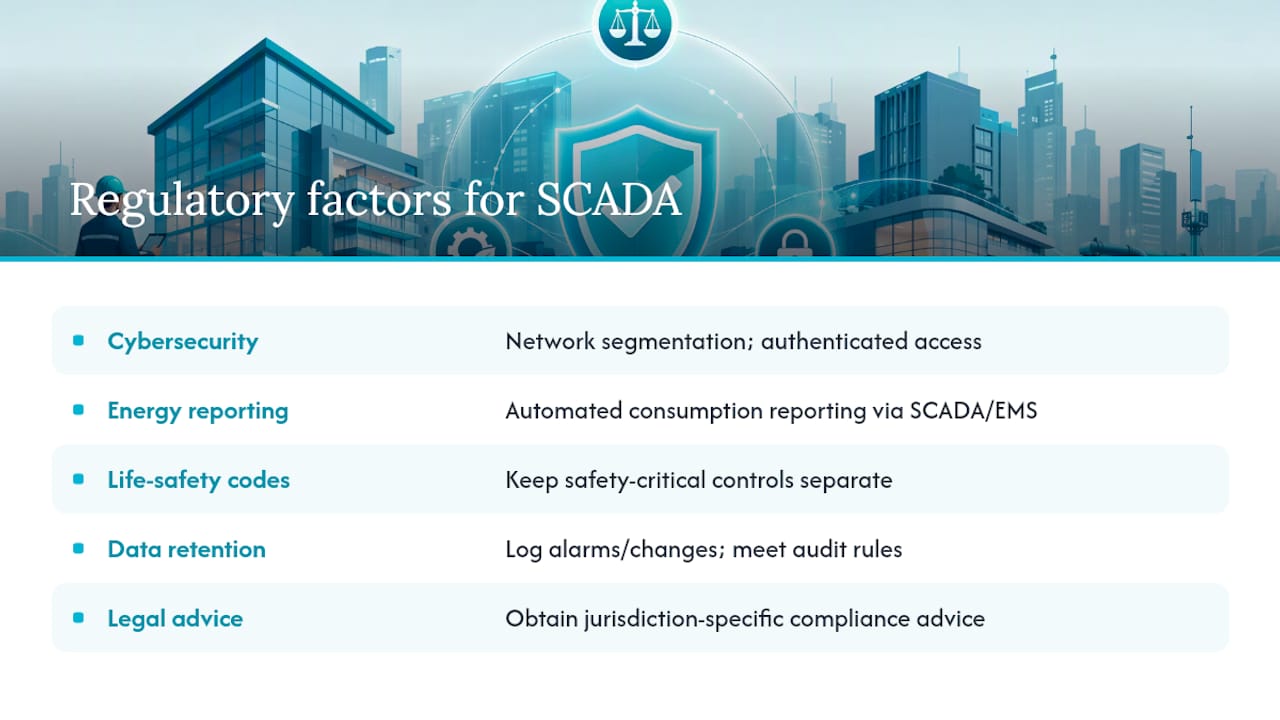
Compliance requirements vary by facility type and jurisdiction, but a few themes recur across most building automation SCADA projects.
Cybersecurity standards matter more than most facility teams initially budget for. Critical infrastructure and industrial control system guidance increasingly expects network segmentation between operational technology and corporate IT, authenticated access, and a documented patching cadence, requirements that stem from frameworks like IEC 62443 for industrial automation security. A SCADA system controlling chillers or a water plant inside a large building falls closer to industrial control system territory than typical office BMS, and should be assessed against that stricter standard.
Energy reporting obligations in many jurisdictions require large commercial buildings to report consumption data, and an integrated SCADA/EMS layer makes that reporting far less manual than pulling numbers from disconnected BMS exports.
Building codes and life safety systems (fire, egress, emergency lighting) typically sit outside SCADA's control scope, and integration projects need to keep clear boundaries between supervisory monitoring and safety-critical control that remains under dedicated, code-compliant systems.
Data retention and audit trail requirements apply where SCADA data supports compliance reporting or incident investigation; the system should log changes and alarms in a way that satisfies whatever regulatory body oversees the facility.
None of this replaces qualified legal or compliance advice specific to a facility's jurisdiction and sector, but it should shape the requirements document before a vendor is selected.
What ongoing maintenance does a SCADA system need after go-live?
Go-live is the start of the operational relationship with a SCADA system, not the finish line.
Operators need structured training that goes beyond a one-day handover session, particularly around alarm response procedures and how to distinguish a genuine fault from sensor drift. Facilities that skip refresher training tend to see alarm fatigue creep back in within months of a clean pilot.
Patching and firmware updates should follow the cadence agreed in the vendor SLA, not an ad hoc schedule driven by whoever remembers to check. Deferred patching is one of the most common ways a previously secure SCADA network becomes a liability.
Data quality needs periodic auditing. Sensors drift, meters get swapped during maintenance, and naming conventions slip when new equipment gets added without discipline. A quarterly review of tag consistency and point health catches problems before they corrupt months of trend data feeding the EMS layer.
Redundancy checks matter too. Dual switches and backup RTU paths only help if someone actually tests failover periodically rather than assuming it works because it was configured correctly at commissioning.
Finally, revisit the original KPIs every reporting cycle. Energy savings, alarm reduction, and response time targets set at the pilot stage should stay the benchmark for ongoing performance, not get quietly forgotten once the system settles into normal operation.
How do you evaluate and select a SCADA vendor for building automation?
Vendor selection should be driven by fit to the estate's actual complexity, not by feature checklists that look impressive in a demo.
Start with protocol coverage. Confirm the platform natively supports whatever mix of BACnet, Modbus, OPC UA, and legacy fieldbus protocols already runs on-site, because every protocol requiring a third-party gateway adds cost and a future point of failure.
Assess deployment speed honestly. A script-heavy legacy SCADA platform might offer deep customisation, but if it takes months to model a single plant, that timeline compounds badly across a multi-site rollout. A no-code, component-based approach, where prebuilt parts replace bespoke scripting, tends to compress modelling timelines considerably for teams without a dedicated scripting resource.
Check the licensing model against the estate's growth plan. Per-PC and per-data-point pricing tiers behave very differently as a portfolio scales from a pilot building to fifty sites, so model the cost curve before committing.
Ask for reference deployments similar in scale and sector to the project at hand, not generic case studies. A vendor's airport or factory deployment tells you more about how the platform handles thousands of distributed points than a marketing brochure ever will.
Finally, weigh vendor responsiveness during the sales process as a proxy for support quality after go-live. A vendor slow to answer technical questions during evaluation rarely improves once the contract is signed.
What are the most common integration mistakes, and how do you avoid them?
Most integration failures trace back to scoping decisions made in the first few weeks, long before any hardware gets touched.
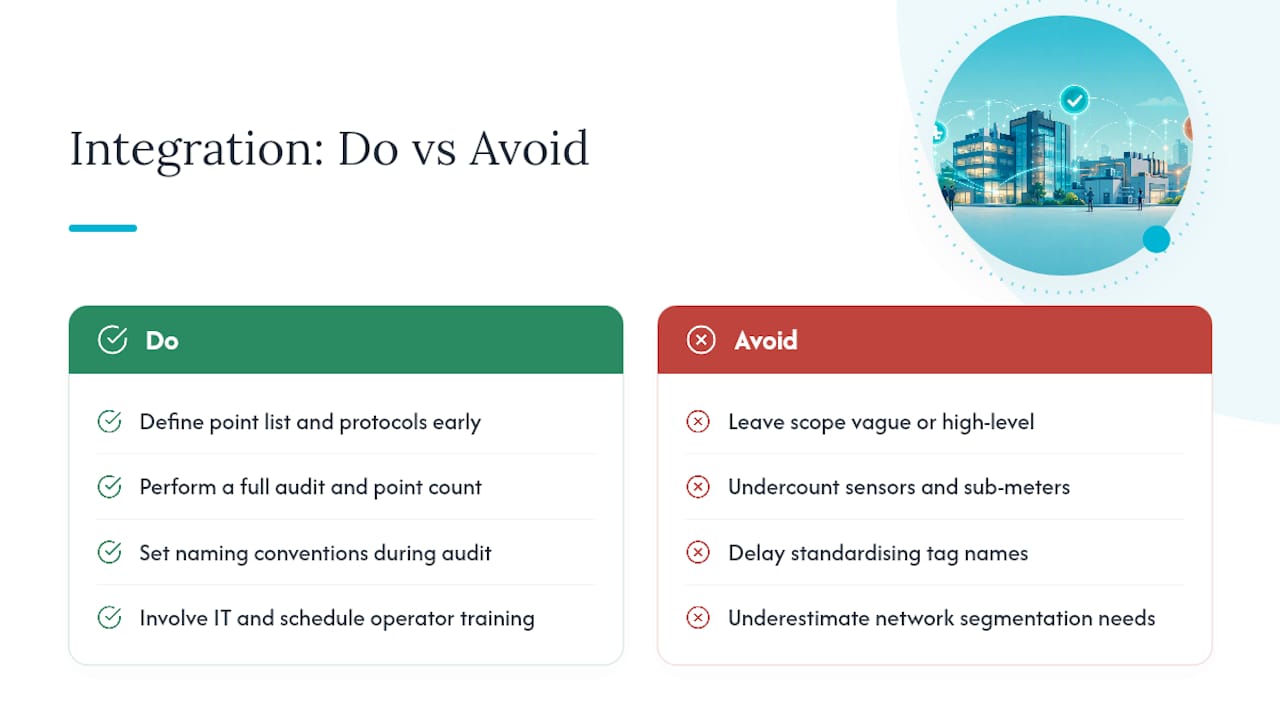
Vague scope is the biggest offender. "Integrate SCADA with our BMS" isn't a scope, it's a wish. Projects need a defined point list, named protocols, and success criteria before procurement even starts, or the vendor ends up guessing at requirements mid-project.
Undercounting data points happens constantly. Facility teams often estimate point counts from what's visible on the current BMS screen, missing sensors and sub-meters that were added informally over the years. That gap surfaces during commissioning, usually as a licensing cost surprise.
Ignoring naming conventions until after go-live is a mistake that compounds. Analytics and EMS models built on inconsistent or duplicate tag names produce unreliable trends, and retrofitting a naming standard across thousands of live points is far more expensive than establishing it during the audit phase.
Underestimating cybersecurity segmentation is another recurring gap, particularly on projects where IT wasn't consulted early. Retrofitting network segmentation after a security review flags it delays rollout and frustrates every stakeholder who thought the project was nearly done.
Skipping operator training to hit a go-live date saves a week upfront and costs months of alarm fatigue and misuse afterward. Build training time into the rollout schedule from the start, not as an afterthought once the pilot's already live.
The fix for nearly all of these is the same: spend more time on the audit and scoping phase than feels comfortable. It's cheaper there than anywhere else in the project.
What procurement mistakes should you watch for?
Vague scope and undercounted data points sink more projects than bad hardware ever does. The highest-return activity isn't picking a platform. It's getting point-count and naming conventions right before procurement starts, then holding the pilot to real KPIs, not vendor promises. Judge a vendor by how fast they answer hard questions during evaluation, not the demo.
— Jeffrey Anastacia
See how a Kingfisher 3D SCADA demo fits your estate
A no-code, browser-based platform provides a practical route for facility teams who want to avoid lengthy scripting and custom asset modelling, delivering a working 3D view of plants or campuses quickly by using a built-in marketplace of domain components instead of starting from a blank screen.

A demo typically walks through your existing point list and protocol mix, then shows how quickly a representative asset, a chiller plant, a meter network, a thermal loop, can be modelled inside the platform. Bring your controls engineer and whoever owns the energy KPIs; both perspectives matter for judging fit. If your estate is a single small building on one protocol, a full SCADA pilot is probably premature, park it and revisit once you're managing multiple sites or a plant with real supervisory complexity.
Ready to see it against your own data? Start with the 3D SCADA platform overview or explore solution examples across industries to find the closest match to your estate before booking a walkthrough.
Sources
- Critical review of SCADA and PLC in smart buildings and energy sector
- Understanding the relationship between BMS, SCADA, and EMS
FAQ
What is SCADA automation?
SCADA automation refers to supervisory control and data acquisition systems that monitor and control distributed industrial or building assets from a central console. It combines real-time data collection from sensors and controllers with the ability to issue supervisory commands, and it's built for scale where thousands of points need coordinated monitoring.
How is SCADA different from a PLC?
A PLC (programmable logic controller) executes local, device-level control logic, like running a specific chiller sequence, while SCADA supervises across many PLCs and other data sources to give a centralised operational view. SCADA doesn't replace PLCs; it aggregates and visualises what they're doing across an entire site or estate, and layers in historical trending and alarm management that individual PLCs don't provide.
What are the four types of SCADA systems?
SCADA architectures are commonly grouped into monolithic (single centralised server, an early architecture rarely used today), distributed (multiple servers sharing the load across a network), networked (distributed systems connected via LAN/WAN for wider geographic reach), and web-based or IoT-enabled SCADA (accessible through browsers, often cloud-connected). Most modern building automation deployments use networked or web-based architectures for flexibility across multi-site estates.
What is the difference between SCADA and BMS?
A BMS controls building-level services like HVAC, lighting, and access at the scale of one or a few buildings, typically operated through a simplified graphical interface. SCADA is industrial-grade supervisory control designed for larger, more distributed asset bases, offering deeper data acquisition and historisation than most BMS platforms provide natively. Platforms like Kingfisher 3D SCADA bridge this gap by connecting to existing BMS protocols like BACnet while adding SCADA-grade visualisation and control.