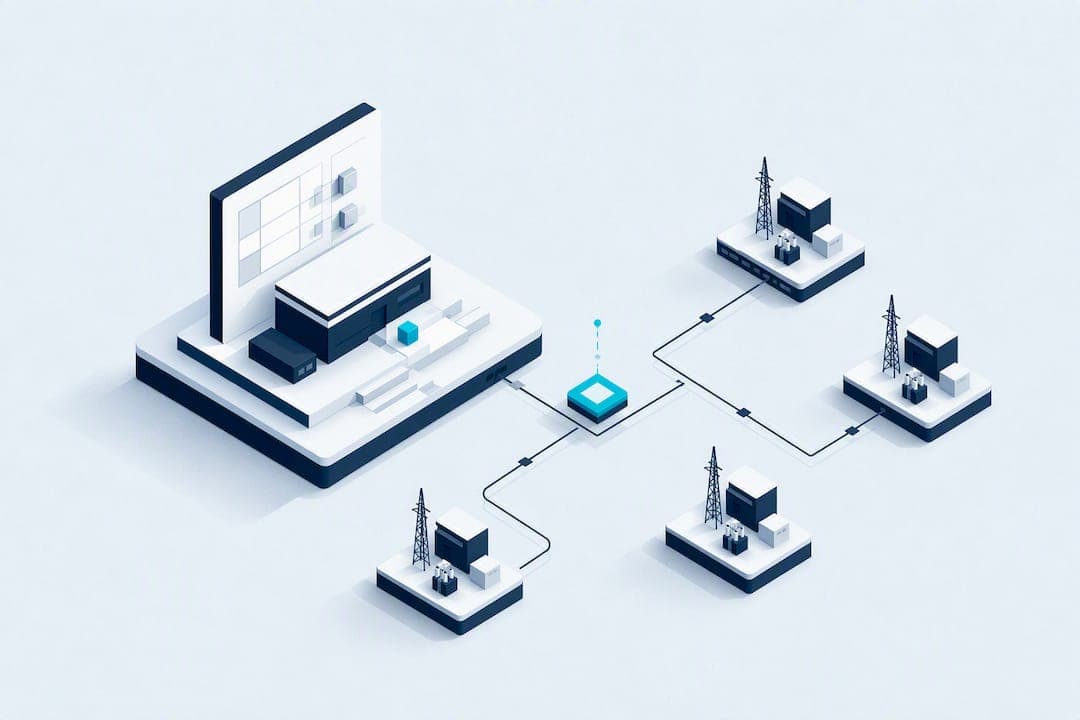
DNP3 is the SCADA communications protocol built for event-driven reporting and timestamped sequence-of-events, which is why it dominates wide-area utility telemetry where bandwidth is scarce and event accuracy matters. It reports by exception rather than flooding the network with constant polling, and its sequence-of-events timestamps let you reconstruct exactly what happened and when. Standardised as IEEE Std 1815, it also supports secure transports engineers can lock down properly.
TL;DR:
- DNP3 excels in wide-area networks by supporting event-based reporting, timestamped events, multi-master operation, and low bandwidth consumption through selective data transmission.
- Proper implementation requires verifying device subset profiles, tuning polling intervals, and testing time synchronization to ensure accurate sequence of events and reliable operation.
- Securing DNP3 involves using TLS over IP links, implementing challenge-response authentication, and continuously managing cryptographic keys to prevent spoofing and unauthorized access.
- DNP3's layered data model and object definitions enable interoperability across vendors, but over-engineering or neglecting security measures can undermine its benefits.
- Visualizing DNP3 data with a no-code 3D SCADA platform transforms raw points into an intuitive digital twin, accelerating fault diagnosis and asset management.
Table of Contents
- What is DNP3 protocol and where does it earn its keep?
- How DNP3's protocol layers and data model actually work
- Securing DNP3 without breaking what makes it useful
- DNP3 vs Modbus vs IEC 61850: which protocol fits?
- Deploying and troubleshooting DNP3 in the field
- Turning DNP3 telemetry into a visual operating picture
- What I'd tell an engineer before their first DNP3 rollout
- Seeing your DNP3 data in a no-code 3D SCADA platform
- Where to go next for the technical detail
- Sources
- FAQ
What is DNP3 protocol and where does it earn its keep?
DNP3 grew out of the electric utility sector in the 1990s and has since become the default choice across water treatment, gas pipelines, and other geographically spread infrastructure where a master station talks to dozens or hundreds of remote outstations over unreliable links. It's an open, standards-based protocol rather than a proprietary one, which is a big part of why it spread so widely across electric and water utility SCADA networks.
Interoperability is maintained through the DNP Users Group (DNP.org), which publishes object libraries and subset profiles that vendors implement against, and through formal IEEE adoption.
The practical benefits show up the moment you deploy over a congested or low-bandwidth link:
- Report-by-exception: outstations send data only when values change, cutting network chatter dramatically.
- Sequence-of-events timestamps: every point can carry a timestamp, so operators can reconstruct the order events actually happened in, not just when they were polled.
- Multi-master and multi-outstation support: one network can serve several control centres without redesigning the topology.
- Reduced bandwidth demand: edge intelligence at the RTU means less raw data has to travel to the central server for processing.
That said, DNP3 is genuine overkill for a single PLC talking to one local controller over a short cable. If there's no wide-area link, no need for SOE reconstruction, and no multi-master requirement, a simpler protocol will get the job done with less configuration overhead.
How DNP3's protocol layers and data model actually work
DNP3 splits its work across three layers: the data link layer (framing, addressing, error checking), the transport layer (fragmentation and reassembly of larger messages), and the application layer (the actual point data and function codes operators care about). Understanding how these interact is what separates a smooth commissioning from a week of chasing phantom faults.
- Application objects and point types. DNP3 defines object groups for binary inputs, analogue inputs, counters, binary outputs, and more. Each has a defined structure, so a binary input on one vendor's RTU should map cleanly to the same object on another's, provided both implement the same subset.
- Class 0 versus Classes 1, 2, and 3. Class 0 is a full integrity poll, a complete snapshot of every point's current value. Classes 1, 2, and 3 are event classes, typically ranked by priority, that carry only changed data since the last read. A well-tuned system runs periodic Class 0 polls to catch anything missed and relies on event classes for real-time updates.
- Frame structure and CRC checks. Each data link frame carries its own CRC, and larger application-layer messages get split into transport-layer segments, then reassembled at the far end. This is why a single corrupted frame doesn't necessarily take down an entire multi-fragment message.
- SOE reconstruction. Because point data objects can carry time-stamped variants, you can reconstruct the true order of events even when polling intervals are sparse, which matters enormously during fault investigation.
Securing DNP3 without breaking what makes it useful
DNP3's early versions had no built-in authentication, which is the criticism you'll still hear from security teams who haven't looked at it since. That changed with Secure Authentication, formalised through IEEE Std 1815, with later revisions (commonly referred to as SAv5) adding public-key based challenge-response mechanisms rather than relying on shared secrets alone.
For transport security, the guidance is clear:
- Use TLS on TCP/IP links, in line with the IEC 62351-3 recommendation for securing DNP3 and similar protocols over IP.
- For serial links, use a bump-in-the-wire encryption device or tunnel the traffic through a VPN, since serial DNP3 has no native equivalent to TLS.
- Segment SCADA traffic away from corporate networks and manage cryptographic keys on a defined rotation schedule, not an ad hoc one.
- Log and actively monitor unsolicited responses, since an unexpected unsolicited message is one of the more reliable early indicators of a spoofed outstation.
Pro Tip: Run a replay-attack test against your own Secure Authentication configuration before commissioning. If an old, valid message can be resent and accepted, your challenge-response setup isn't actually doing its job.
Time synchronisation checks and periodic conformance testing against the DNP Users Group's subset profiles round out a sound hardening routine.
DNP3 vs Modbus vs IEC 61850: which protocol fits?
None of these protocols is universally "better." Each was built for a different problem, and picking wrong just means fighting the protocol for the life of the project.
- Choose DNP3 when you've got wide-area links, unreliable communications, and a genuine need for SOE reconstruction and event prioritisation, such as substation-to-control-centre links spanning many kilometres.
- Choose Modbus when the device is simple, the link is local and reliable, and you don't need class-based eventing. It's still the right call for a lot of low-capability field devices.
- Consider IEC 61850 when you're working inside substation automation itself, where its richer object model and native support for peer-to-peer messaging between protection devices outperforms both DNP3 and Modbus.
- Use bandwidth and device capability as your first filter. If the RTU can't support DNP3's object model, no amount of protocol enthusiasm will fix that.
Regulatory context matters too. Some regional grid codes effectively mandate DNP3 or IEC 60870-5 (IEC 104) for utility telemetry, so check compliance requirements before locking in a protocol choice.
Deploying and troubleshooting DNP3 in the field
Getting a DNP3 network right in commissioning saves weeks of chasing ghosts later. Work through it in order:
- Pick your transport deliberately. Serial RS-485 or RS-232 still suits legacy RTUs and short local runs, while TCP/IP on port 20000 is the standard for anything routed across a wider network or through modern gateways. Migrating from serial to TCP/IP mid-project is common but needs its own testing pass, not a quick swap.
- Verify the outstation's subset profile. Vendors implement different object subsets, and checking each device's documented profile against what your master station expects avoids painful mismatches during commissioning, not after.
- Tune your polling strategy. Schedule integrity (Class 0) polls at a sensible interval, prioritise event classes correctly, and configure how unsolicited responses are handled so they don't overwhelm the master during a cascading fault.
- Run the diagnostics checklist. Watch for CRC and frame errors, check time drift on each RTU's clock, confirm no events are being silently dropped, and use a protocol analyser during commissioning rather than waiting for a live incident.
Time drift is worth calling out specifically: end-to-end testing of time synchronisation is one of the most commonly skipped steps, and it's also the most common root cause when an SOE reconstruction doesn't match what operators actually observed in the field.
Turning DNP3 telemetry into a visual operating picture
Raw DNP3 point lists are precise but not exactly intuitive. Engineers spend real time cross-referencing tag names against physical assets during a fault, which is dead time you don't get back during an outage.
The practical flow looks like this:
- Ingest the DNP3 telemetry stream from the master station.
- Map each point object (binary input, analogue input, counter) to a corresponding 3D asset in the model.
- Bind the SOE timestamp data to a visual timeline so operators can scrub back through an event sequence rather than reading a raw event log.
When a pump trips at 2am and three alarms fire within four seconds, the difference between a five-minute diagnosis and a forty-minute one usually comes down to whether the operator can see the fault physically located on the asset, in the order it actually occurred.
That's the operational payoff of pairing DNP3's timestamped event data with a spatial model rather than a scrolling text log. Fault isolation gets faster because operators see which asset tripped first, not just which tag changed. New operators also ramp up faster on a visual twin than on a tag list they've never memorised. Readers building water or electrical telemetry into a SCADA solution can see how point mapping works against real electrical components in practice.
What I'd tell an engineer before their first DNP3 rollout
Three mistakes show up again and again. Engineers over-engineer simple point-to-point links with full DNP3 stacks they don't need, skip verifying the outstation's subset profile until commissioning day, and treat key management as a one-time setup rather than an ongoing discipline.
Full DNP3 features, including Secure Authentication and multi-class eventing, earn their complexity on wide-area, multi-outstation networks. For a single local device, a lighter implementation, or even Modbus, will serve you better and cost less to maintain.
— Jeffrey Anastacia
Seeing your DNP3 data in a no-code 3D SCADA platform
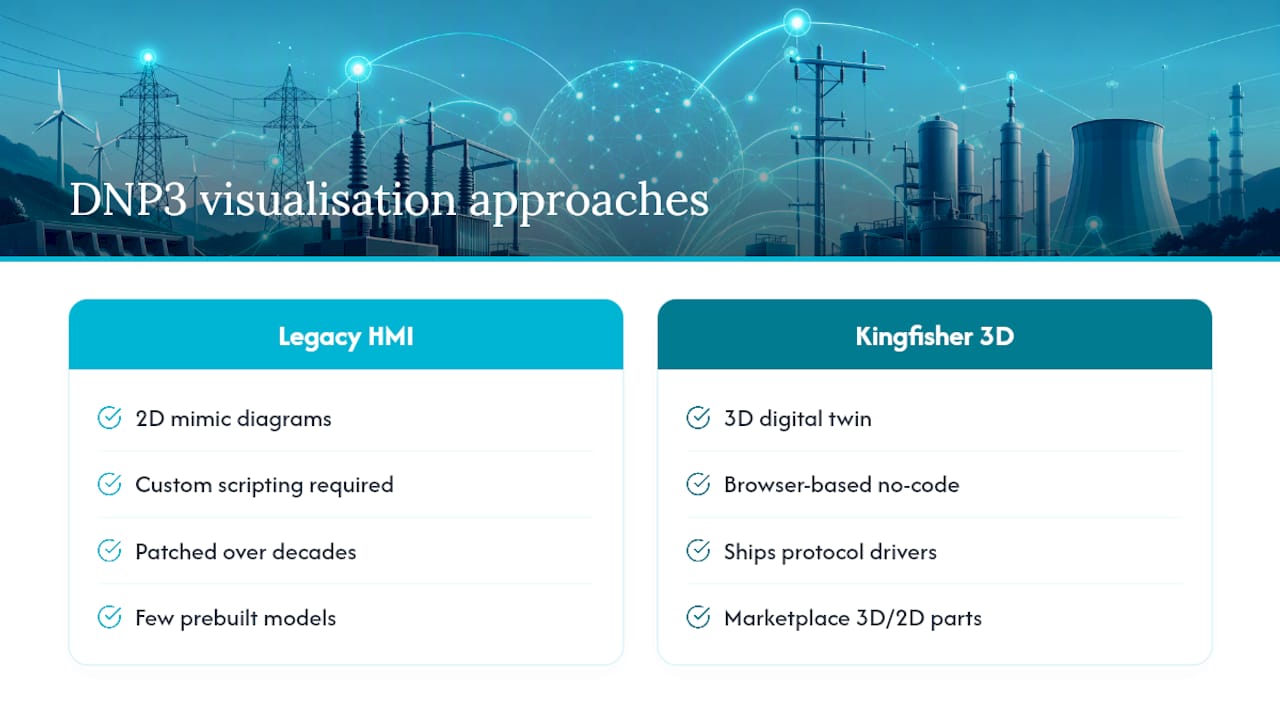
There's more than one way to visualise DNP3 telemetry, from custom-built HMI screens to legacy 2D SCADA graphics teams have patched together over a decade. Kingfisher takes a different route: a browser-based, no-code platform where you drag DNP3 points onto a 3D digital twin instead of scripting a static mimic diagram from scratch.
Kingfisher ships with drivers for common industrial protocols, a no-code binding tool that connects point data to a visual asset without writing a line of code, and a marketplace of ready-made 3D and 2D components, so you're not modelling a pump housing from a blank canvas. Engineers working in water, electrical, or thermal networks can pull components straight from the SCADA marketplace and bind SOE-timestamped events to them directly.
If you're weighing up whether your next DNP3 integration needs a visual layer, take a look at the 3D SCADA platform and request a demo to see your own asset data rendered as a working digital twin.
Where to go next for the technical detail
For the underlying standards and vendor-level detail this article draws on, these are worth bookmarking directly:
- Dnp — object libraries, subset profiles, and benefits documentation.
- DNP3 / IEEE Std 1815 overview — protocol history, classes, and Secure Authentication.
- DNP3 Driver Guide — vendor-level configuration steps.
Sources
FAQ
What is DNP3 in SCADA?
DNP3 is an open communications protocol that lets a master station poll and receive data from remote outstations (RTUs or IEDs) using event-driven reporting and timestamped sequence-of-events, standardised as IEEE Std 1815.
Why is DNP3 better than Modbus for certain applications?
DNP3 handles wide-area, unreliable links better because it reports by exception, timestamps events for SOE reconstruction, and supports multiple masters, while Modbus lacks native eventing and is better suited to simple, local, reliable connections.
What does DNP3 stand for?
DNP3 stands for Distributed Network Protocol, version 3, the protocol generation that became the de facto SCADA standard across utilities and was later formalised as IEEE Std 1815.
What are the four types of SCADA systems?
SCADA architectures are generally described in four generations: monolithic (isolated, single-vendor systems), distributed (networked across multiple stations), networked (using standard protocols like DNP3 or IEC 104 across wide areas), and internet-of-things or IoT-based systems that add cloud connectivity and modern visualisation layers, such as browser-based 3D digital twin platforms.
Does DNP3 support secure authentication over TCP/IP?
Yes. DNP3 over TCP/IP should run behind TLS in line with the IEC 62351-3 recommendation, combined with Secure Authentication features from later IEEE Std 1815 revisions for challenge-response protection at the application layer.