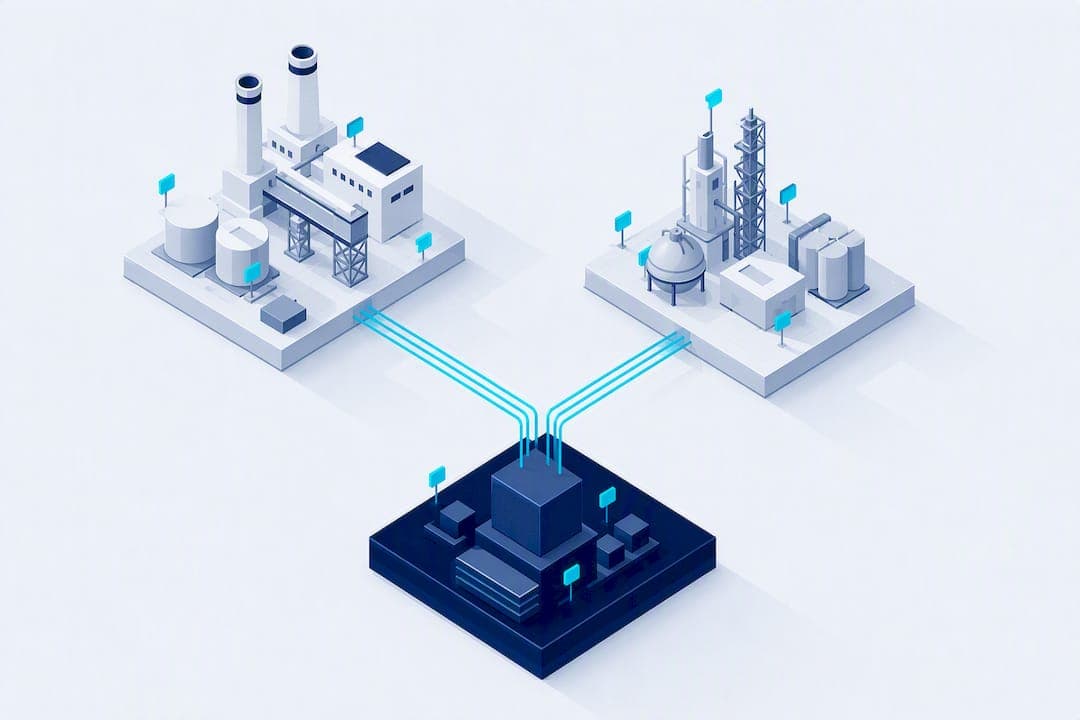
Federated digital twins, in operational terms, are browser-based 3D SCADA models that unify live data from multiple plant systems into one interactive view, built without writing code. The payoff is immediate operational visibility across assets that used to live in separate 2D screens, plus faster commissioning because logic gets tested in the model before it touches the floor. They sit on top of existing SCADA and MOM systems rather than replacing them, working as an intelligence layer for teams that need answers fast.
TL;DR:
- A successful pilot typically takes 10 to 14 weeks, focusing on one or two assets with high downtime costs and measurable improvements.
- Native support for OPC UA, Modbus, BACnet, and Siemens S7 protocols is essential to ensure seamless data integration for the twin.
- Ownership should be led by operations, with IT and controls partnering continuously to maintain data accuracy and update processes.
- KPIs such as downtime reduction, decreased MTTR, improved OEE, and faster commissioning demonstrate the twin's operational value.
- Starting with a narrow scope and validated data ensures the project proves its worth before scaling to larger plant sections.
Table of Contents
- What are federated digital twins in an industrial setting?
- What operational problems do these twins actually solve?
- What data and protocol connections does a twin need?
- How do you roll out a pilot without it stalling?
- Who should own the twin day to day?
- Which KPIs prove the twin is paying off?
- Why most twin projects fail before they start
- What to check before you commit to a pilot
- Sources
- FAQ
What are federated digital twins in an industrial setting?
Here the term describes something specific: a living, operational 3D representation of a plant or asset, fed by real-time data, that engineers and operators actually use for monitoring and decisions. That is different from the engineering-only 3D models used purely for design review, and different again from academic notions of distributed twin architectures across organisations. Neither of those helps a shift supervisor spot a failing pump at 2am.
No-code, browser-based delivery is what makes this practical. There is no client software to install, no scripting layer between the operator and the data, and no dependency on a specialist 3D developer to update the scene when a line changes. Industry guidance on real-time 3D confirms this is a meaningful shift from static CAD walkthroughs or laser-scan snapshots, which go stale the moment equipment moves. Expect most rollouts to start with a single line or utility system rather than a whole site. Fidelity should match the decision being made, not the marketing brochure.
What operational problems do these twins actually solve?
The clearest win is situational awareness. Instead of toggling between five 2D SCADA screens and a paper P&ID, operators see the whole system spatially, with alarms and trends bound directly to the equipment they refer to. That cuts the time spent figuring out where a fault is before anyone starts fixing it.
Virtual commissioning is the second major use case. Automation teams can test PLC logic and sequencing against the twin before it ever reaches a live panel, catching sequencing errors in a safe environment rather than during a shutdown window. Predictive maintenance follows naturally once the twin is wired into condition data. It can trigger a CMMS work order automatically when a vibration or temperature trend crosses a threshold, rather than waiting for a technician to notice on a walk-round.
Quick wins operations teams typically target in the first pilot:
- Reducing time-to-locate for fault diagnosis on a critical line
- Trialling one virtual commissioning sequence before a physical changeover
- Auto-generating a maintenance work order from a live sensor threshold
- Giving a remote engineer visual access to an asset without a site visit
Time-to-value on a well-scoped digital twin project tends to land in three to six months rather than years, especially when it runs in parallel with the existing SCADA stack instead of waiting for a full replacement.
What data and protocol connections does a twin need?
Before scoping a pilot, work through a short technical checklist:
- Confirm protocol coverage: OPC UA, Modbus, BACnet and Siemens S7 cover most industrial equipment, and any credible platform needs native drivers for all four, not just the easy ones.
- Identify context sources beyond live tags: the SCADA historian for trend data, MES for production context, CMMS or EAM for maintenance history, and CAD or BIM files for the 3D geometry itself.
- Check data quality and time alignment. Tags drifting out of sync across systems will make a twin misleading rather than useful, and this is worth auditing before a single 3D asset gets built.
- Decide where protocol translation happens. IIoT middleware or an edge gateway is often the practical answer when equipment speaks a protocol the twin platform does not natively support.
Cloud vendor documentation on twin architecture makes the same point from a different angle: OPC-UA endpoints and historian ingestion are the backbone of most production deployments, and managed services still need that groundwork done properly before scaling.
Pro Tip: Run a two-week data audit before committing to a pilot scope. If tag naming is inconsistent across your historian and MES, fix that first. A beautiful 3D model fed by messy data is still a messy twin.
How do you roll out a pilot without it stalling?
Asset selection decides whether a pilot succeeds. Pick equipment where downtime has an obvious cost, where sensors already exist, and where a fix or improvement is measurable within weeks, not quarters. A minimum-viable twin approach built around one or two such assets consistently outperforms an ambitious full-site model that takes a year to see daylight.
The phased path looks like this in practice:
- Connect data first. Wire in SCADA historian tags and CMMS records before building anything visual.
- Build a baseline model. Model the chosen asset or line, bind live tags, and get alarms and trends showing correctly.
- Validate against reality. Compare the twin's readings and alarm behaviour with what operators already know to be true on the floor.
- Integrate with workflows. Push twin-triggered alerts into CMMS work orders from day one, so adoption happens through existing habits rather than a new tool nobody opens.
- Scale deliberately. Add the next asset or line only once the first is delivering trusted, daily-use value.
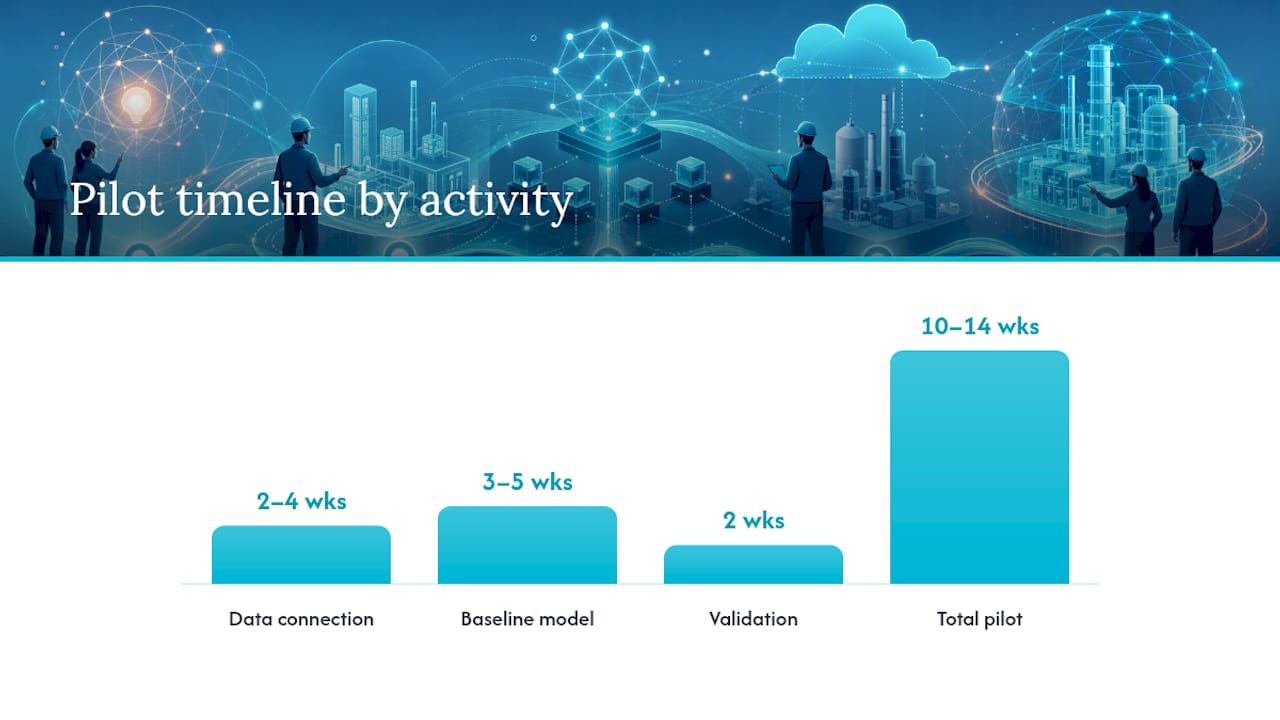
Typical durations run two to four weeks for data connection, three to five weeks for the baseline model, and two weeks for validation, putting most MVPs at 10 to 14 weeks to a production-ready pilot. Pilot purgatory happens when teams skip validation or delay the CMMS integration step. A twin that never touches a real work order stays a demo forever.
Resourcing needs an operations lead who owns the use case, a controls or automation engineer for protocol and PLC context, an IT or OT contact for network and security, and one executive sponsor who can unblock access to systems when a request gets stuck in a queue.
Who should own the twin day to day?
Ownership works best as operations-led, with IT and controls as a standing partnership rather than a one-off project team. Operations understands what decisions the twin needs to support; controls and IT keep the data pipes and security posture sound.
Change control matters more than most teams expect. Every asset move, tag rename, or new sensor needs a defined process for updating the 3D model and its data mappings, otherwise the twin quietly drifts out of sync with the plant it represents. The twin earns its keep by showing up inside tools people already use: HMI screens, CMMS work order queues, shift handover routines. A twin that lives in its own separate app, checked once a week, will not survive budget season. Set a governance cadence, monthly is common, to review configuration changes, new use cases and training needs as the plant evolves.
Which KPIs prove the twin is paying off?
Track a short list of numbers, not a dashboard full of vanity metrics. The primary ones:
- Downtime reduction on the pilot asset compared with a pre-twin baseline period
- MTTR (mean time to repair), since faster fault location should show up here first
- OEE shifts on the specific line, not the whole site, in the early months
- Commissioning time saved on any virtual commissioning exercise run through the twin
Baseline every metric for four to six weeks before go-live, then compare against the same window post-deployment. Report monthly to the operations sponsor and quarterly to the executive sponsor, with the first genuine win, however small, called out specifically rather than buried in a general update.
Why most twin projects fail before they start
The industry's biggest misconception about federated digital twins is that they need a full digital transformation strategy behind them. They don't. The projects that work start narrow, on one asset with a clear cost of downtime, and expand only after proving value. The projects that stall are the ones that tried to model an entire site before anyone had used the thing.
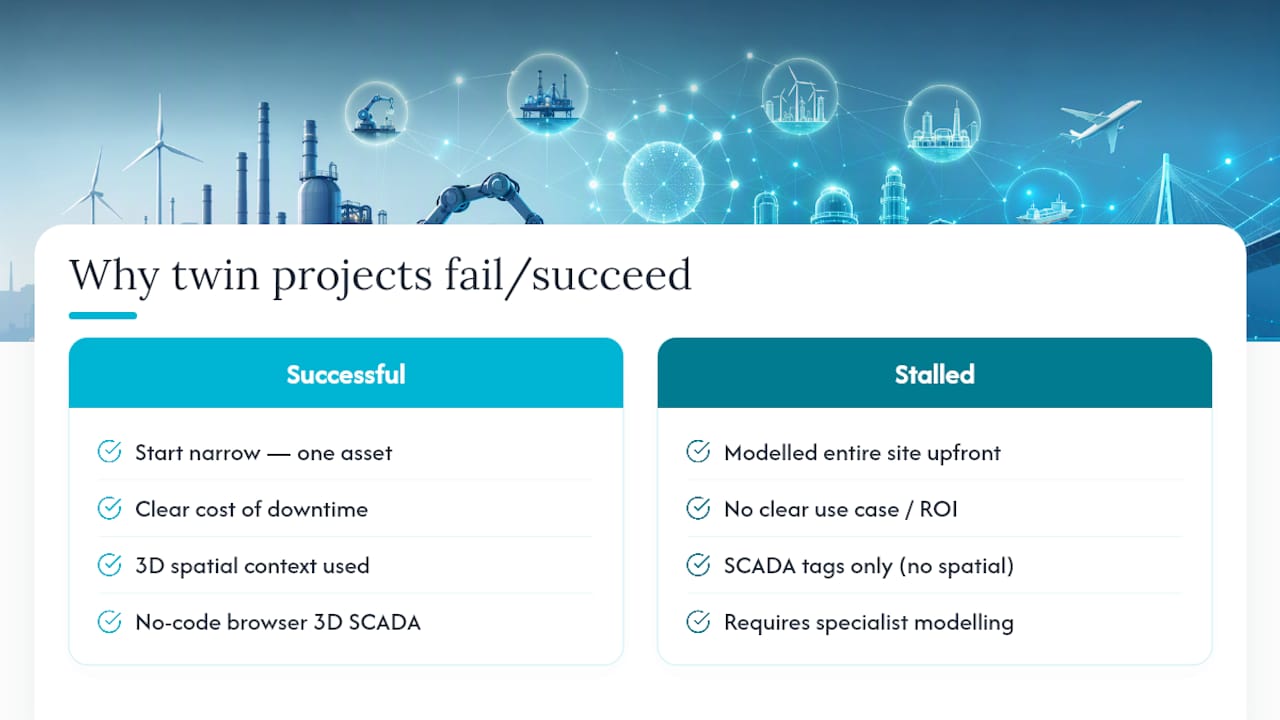
There's also a persistent myth that 3D visualisation is a nice-to-have layered on top of "real" SCADA data. In practice, spatial context is what turns a wall of tags into something an operator can act on in seconds rather than minutes. An approach that reflects that philosophy directly is a no-code, browser-based 3D SCADA platform with AI-assisted scene generation and a marketplace of ready-made components, aimed at cutting modelling time rather than adding another specialist skillset to the project team. Its case studies include a digital twin management platform built for an international airport, an environment where asset density and operational complexity make manual 3D modelling impractical at scale.
The gap between what digital twin vendors promise and what plant floors actually need usually comes down to one thing: whether the operator without a computer science degree can open the model, understand it, and act on it inside a single shift.
— Jeffrey Anastacia
What to check before you commit to a pilot
A practical route into federated digital twins for teams that don't have a 3D specialist on staff and don't want a multi-year systems integration project relies on drag-and-drop scene creation, AI-assisted generation from schematics or photos, and a component marketplace that removes weeks of manual modelling work.
When you're evaluating a vendor demo, ask for four things: live no-code modelling in front of you, not a canned video; confirmation of driver support for OPC UA, Modbus, BACnet and Siemens S7; a walkthrough of the asset marketplace relevant to your industry; and a working example of live-data binding to alarms and trends. For a pilot request, get specific on scope, an agreed trial data limit, what deliverables mark the pilot complete, and how the per-PC, per-data-point licensing scales from pilot to production.
Start by reviewing the 3D SCADA platform overview or, if your priority is a specific vertical, the industry solutions page for architecture and integration detail relevant to your plant.
Sources
- Benefits of Digital Twins in Manufacturing Systems | Accenture
- Digital Twins in Manufacturing: Implementation Guide 2026
FAQ
What Is a Federated Digital Twin in This Context?
It is an operational, no-code 3D SCADA model that pulls live data from plant systems into one browser-based view for monitoring and control, distinct from engineering-only 3D models.
How Long Does a Digital Twin Pilot Take?
A well-scoped minimum-viable pilot typically runs 10 to 14 weeks from data connection to a validated, production-ready model on one or two assets.
Which Protocols Does a 3D SCADA Twin Need to Support?
At minimum, look for native drivers for OPC UA, Modbus, BACnet and Siemens S7, since these cover most industrial equipment across manufacturing, energy and water sites.
Do Federated Digital Twins Replace Existing SCADA Systems?
No. They typically run as an added intelligence layer alongside existing SCADA and MOM systems, unifying their data rather than replacing the underlying control infrastructure.
Who Should Own the Digital Twin Once It's Live?
Ownership works best under operations, in an ongoing partnership with IT and controls, with an executive sponsor to support cross-system access and governance decisions.
What KPIs Show a Digital Twin Is Working?
Downtime reduction, MTTR, OEE shifts on the pilot line, and commissioning time saved are the primary metrics to baseline before go-live and track in the following months.